Physical Address
304 North Cardinal St.
Dorchester Center, MA 02124
Physical Address
304 North Cardinal St.
Dorchester Center, MA 02124
Is AI yet another populist concept to brainwash and homogenise us all into submission?
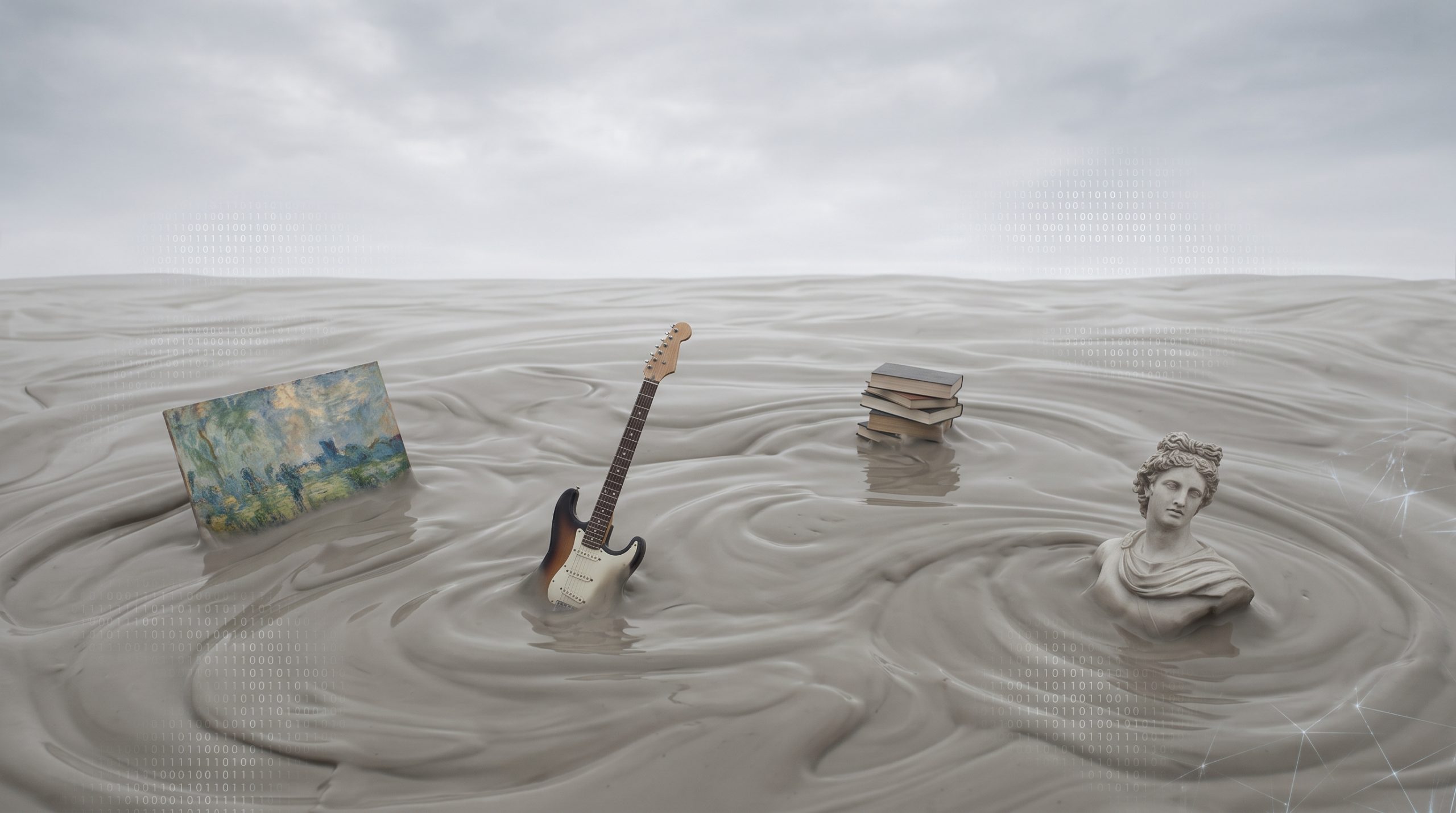
We are repeatedly told that we are on the precipice of a creative revolution. The prevailing narrative suggests that artificial intelligence will soon paint, compose, and write with the same vitality as any human artist. Yet, stepping back to actually examine the output, the reality feels far less revolutionary. Instead of a new avant-garde, we are witnessing the dawn of the “creative mush”—a vast, algorithmically generated landscape of perfectly competent, utterly generic art.
The core issue is that AI does not create; it extrapolates based on averages. Take Google’s “Art Zoom Out” project as a prime example. The tool invites users to take a famous painting and use generative AI to see what exists “beyond the frame.” The AI happily obliges, analyzing the existing brushstrokes and endlessly extending the scenery to fill the screen. https://artsandculture.google.com/art-zoom-out

But this fundamentally misunderstands the nature of visual art. A canvas’s edge is not an accident or a limitation of materials; it is a deliberate, structural constraint. The artist chose exactly what to include and, crucially, what to leave out. The tension, the focus, and the narrative exist entirely within those specific borders. By letting a machine learning model extrapolate the scenery based on statistical probability, the original masterpiece is diluted into endless, meaningless wallpaper. It fills the void with mathematically safe filler, destroying the intentionality of the composition.
This same homogenization is washing over audio. Feed a prompt into an AI music generator like Suno, and it will instantly spit back a fully arranged, engineered track. The algorithm knows the structural rules of a pop song, the standard tempo of a club track, and the typical instrumentation of a rock anthem. Yet, the results invariably sound hollow and uninteresting.
It is music without friction. When an algorithm generates a track, it lacks the deliberate oddities that give music its character. There is no analog synth pushed slightly too hard into a mixer, no drum machine sequenced with a strange, unintended groove, and no vocal delivery carrying the weight of actual lived experience or spontaneous emotion. Suno simply averages out decades of recorded human expression into a sterile, genre-compliant paste. It creates a flawless, frictionless sheen that passes through the ears without leaving a trace.
Human creativity is driven by intent, limitation, and emotion. It is defined by the mistakes kept in the final mix, the deliberate imperfections, and the hard boundaries drawn around a canvas. A machine learning model doesn’t have a point of view; it only has a dataset. It cannot feel the urge to rebel against its own parameters, nor can it experience the world it is trying to depict. Until it can, its output will remain a reflection of a reflection—a highly polished, endlessly expanding mush.